Small Companies Reply Three Times More Often. Your List Should Reflect That.
By Anansio Team · July 27, 2026 · 5 min read
Most of the outbound advice you read was written by someone selling into a company with four thousand employees. The cadences, the multi-threading, the "map the buying committee" step, the CRM hygiene: all of it assumes a target with a procurement process and a VP who owns a budget line. If you sell to businesses with eleven people and an owner who answers their own phone, you have been running a playbook built for a different animal.
There is now a large dataset that says the animal you are hunting is the easier one.
The numbers, plainly
An agency published an analysis of 7,530,489 cold emails sent through 2025, with 34,393 tracked replies. The overall reply rate was 0.45% of emails sent. The segments are the interesting part:
- Companies with 0 to 10 employees: 0.72%
- Companies with 11 to 50 employees: 0.49%
- Companies with 10,000+ employees: 0.22%
- Founders and owners: 0.57%
- C-level: 0.42%
- VPs: 0.32%
So a recipient at a ten-person business is more than three times as likely to answer you as a recipient at an enterprise, and the founder is roughly 1.8 times more likely to answer than the VP.
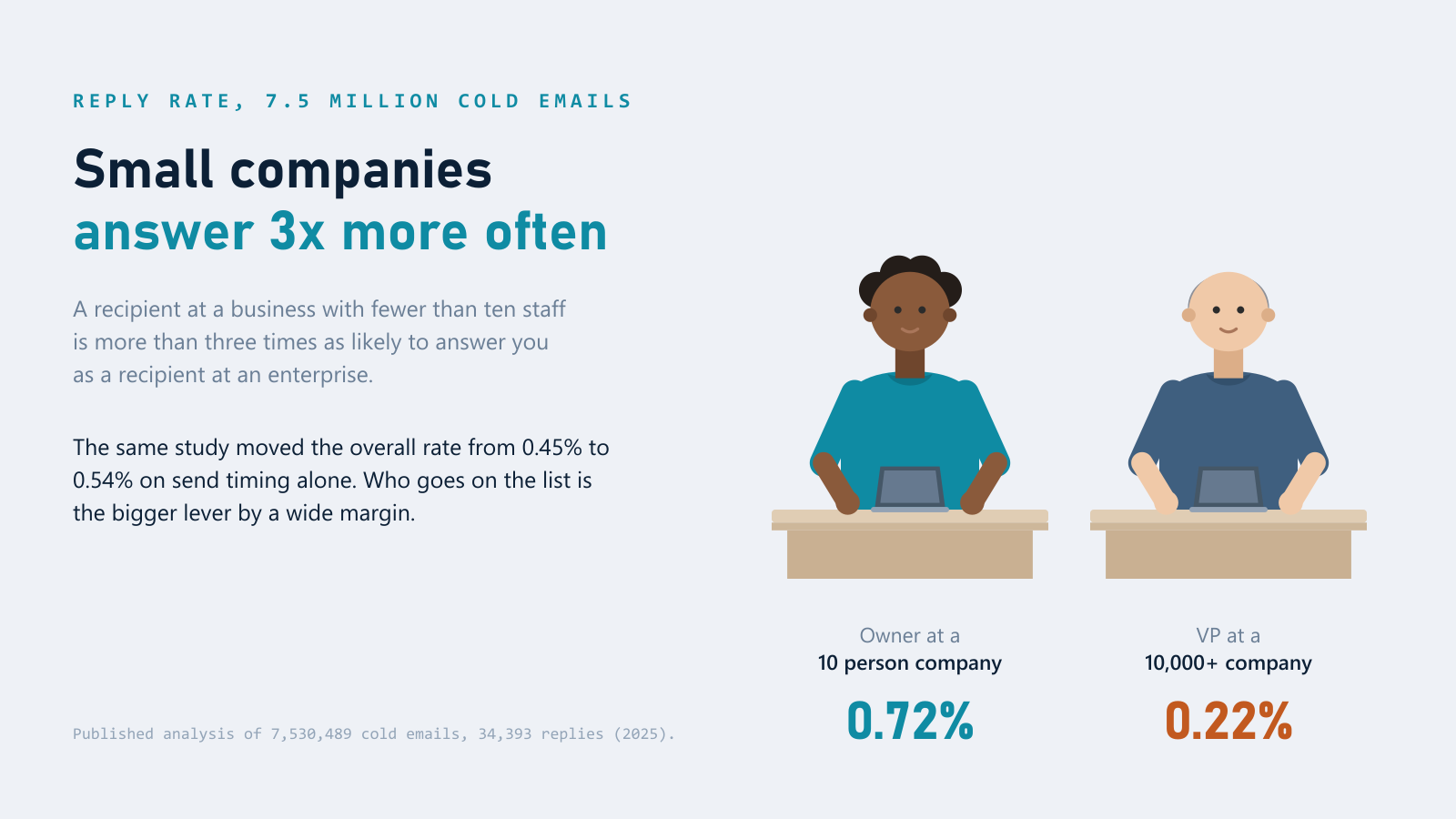
Those gaps are wider than most of the tactical levers people obsess over. Send timing in the same dataset moved things from about 0.45% to 0.54% at best, which is real and much smaller than the difference between writing to an owner and writing to a VP.
Why nobody tells you this
Two reasons, and neither is a conspiracy.
The first is that the people producing outbound content mostly sell enterprise software, so they write about the problems of enterprise selling. Long cycles, many stakeholders, gatekeepers. Their advice is correct for their world.
The second is arithmetic. A 0.72% reply rate on a hundred small businesses gives you fewer conversations than 0.22% on ten thousand enterprise contacts, if you can actually reach ten thousand enterprise contacts affordably. Volume plays can survive a low reply rate. You probably cannot, because your list is bought a contact at a time and your sender reputation is a single domain that takes months to rebuild.
Your version of the game rewards hit rate over volume, and hit rate is exactly what the small end of the market gives you.
What to change about the list
Move your size band down, on purpose. If your ideal customer profile currently reads "50 to 500 employees" because that felt serious, test the band underneath it. A 15-person agency that needs what you sell has one person to convince and no committee to survive.
Write to the person who owns the outcome, not the function. At a company of twelve, the founder is the head of sales, the head of ops, and the person who will feel the problem you solve. At a company of four thousand, they are three layers away from it and their inbox is defended.
Screen for signs of life before you screen for fit. Small-company data ages badly. The business closed, the founder moved on, the address on the listing is a coworking space they left in 2023. A dead row costs you a bounce, and bounces are the fastest way to damage a sending domain that you need working next month.
Keep the list short enough to read. The advantage of targeting the small end is that you can write something specific about each business. Losing that advantage to volume gives you the worst of both approaches.
One honest caveat about that 0.45%
The headline number is replies divided by emails sent, per message. A lot of the reply rates you see quoted elsewhere are per prospect across a whole sequence, which is a different denominator and a much bigger number. Do not put those side by side, in your own reporting or in anyone's pitch deck. The comparison that matters here is internal to the study: the same denominator applied across segments, showing small beats large by three times.
Treat the absolute figures as a shape rather than a promise. Your industry, offer, and list quality will move them.
The reason this is hard in practice
Small businesses are underserved by the tools, which is the flip side of them being underserved by the incumbents' sales teams. Contact databases are built around the companies that buy contact databases, so coverage thins out exactly where the reply rates get good. You end up on directory sites, in maps listings, and on company websites at eleven at night, copying an email address into a spreadsheet and hoping it still works.
That friction is why a lot of people quietly drift back upmarket. The enterprise list is easier to buy, so it wins by default, even though it answers less.
Where Anansio fits
You describe the business you want to reach in plain English, including the size band, and get back real companies that match, with verified contacts included. One credit unlocks a company and every contact at it, so screening a fifteen-person business does not cost more per useful name than screening a large one. Drafting, sending, and follow-ups sit in the same place, so a short, specific list never needs exporting anywhere.
The reason that matters for this particular argument: when picking companies stops being the expensive step, you can afford to aim at the segment that actually replies instead of the segment that is easy to buy.
Try the smaller band
Take your next campaign. Run your usual search, then run a second one with the employee band cut to a third of its current size and the recipient set to owners and founders rather than titled functions. Cap both lists at the same number of sends so it is a fair test.
Send the same offer to both. If the smaller companies answer at a better rate, you have found your leverage, and it costs nothing but a change to the way you describe who you want. You can run that first search free, with 200 welcome credits and no card, before you decide anything.